



On-Demand Elite Cybersecurity Leadership Without Compromise.
In today’s threat landscape, security leadership isn’t optional—it’s existential. Sapien9 delivers executive-grade cybersecurity strategy overhead of a full-time hire. Our Fractional CISO model embeds seasoned expertise into your organization, aligning security with business outcomes and brand integrity.
Who It’s For
High-growth startups scaling fast but lacking cyber leadership
Mid-market firms facing compliance pressure or investor scrutiny
Enterprises seeking strategic augmentation or transition support
Boards and CEOs demanding clarity, confidence, and control
Our Edge
Led by Dr. Marcelo Peredo, former CISO for major public agencies, architect of resilient security cultures and advanced risk methodologies.
Sapien9 Signature Approach: Premium branding meets intelligent defense. Every engagement is tailored, symbolic, and outcome-driven.
Transparent, Agile, Impactful: No fluff. No lag. Just elite strategy delivered with precision.
Engagement Models
Retainer-Based Leadership: Ongoing strategic oversight, available weekly or monthly.
Project-Based Initiatives: Risk assessments, compliance audits, or program builds.
Crisis Response: Immediate leadership during breach or regulatory events.
Ready to Elevate Your Cyber Posture?
Let’s architect a security strategy that protects your brand, empowers your growth, and earns stakeholder trust.

Supported Frameworks













Our vCISO service delivers seasoned cybersecurity leadership that embeds seamlessly within your organization. Whether you are building a security strategy, navigating complex compliance landscapes, or proactively mitigating risk, our vCISO operates as a strategic partner to your executive and IT teams ensuring your security posture is not only resilient but fully aligned with your business objectives.
A Virtual Chief Information Security Officer (vCISO) is a senior cybersecurity executive who provides strategic security leadership on a flexible, remote basis. Unlike a full-time CISO, a vCISO offers scalable expertise tailored to your organization’s size, structure, and risk profile without the overhead of a permanent hire.
vCISOs work directly with executive and technical teams to design, implement, and oversee cybersecurity programs that protect infrastructure, data, people, and customers. They bring board-level insight and operational rigor to organizations that may lack in-house security leadership or need to augment existing capabilities.
A Virtual Chief Information Security Officer (vCISO) delivers high-level cybersecurity leadership without the cost or commitment of a full-time hire. Operating remotely, a vCISO integrates with your organization to provide strategic guidance, risk oversight, and resilience tailored to your business model, regulatory landscape, and growth plans. For companies without a dedicated security executive, a vCISO fills the gap efficiently, especially during leadership transitions or early-stage scaling.
vCISOs are valued for delivering impactful security leadership on a flexible basis. They collaborate with executive and technical teams to align cybersecurity with business goals, assess threats, and guide strategic initiatives. Their scope includes real-time threat analysis, compliance oversight, long-term planning, and team enablement ensuring your security posture evolves with your enterprise.
Core responsibilities include risk assessment and mitigation. vCISOs identify vulnerabilities, evaluate impact, and implement controls aligned with your risk tolerance and industry standards. They also develop and enforce policies to meet frameworks like NIST, ISO 27001, HIPAA, PCI-DSS, and GDPR ensuring compliance and audit readiness.
Incident response is another key function. vCISOs design and test protocols, lead breach containment, and conduct post-incident reviews to strengthen resilience. They also foster a culture of security awareness through tailored training that reduces human risk and promotes accountability.
vCISOs add strategic value in technology and vendor evaluation. They assess tools, platforms, and services for fit, performance, and cost-effectiveness bringing an external lens to challenge assumptions and uncover blind spots.
Finally, vCISOs deliver board-level reporting and executive communication. They translate complex metrics into actionable insights, support leadership decisions, and reinforce investor confidence. By combining strategic foresight with hands-on expertise, a vCISO helps your organization stay secure, compliant, and future-ready.
Security Program Development – Design and implement a comprehensive cybersecurity program tailored to your organization’s business model, risk profile, and regulatory obligations. This includes defining policies, controls, and governance structures that evolve with your enterprise.
Risk Assessment and Management – Identify, evaluate, and prioritize cyber risks across infrastructure, data, and operations. Deliver actionable mitigation strategies that align with business impact and ensure continuous risk monitoring.
Compliance Roadmap Creation – Develop a strategic roadmap to meet regulatory requirements such as GDPR, HIPAA, PCI-DSS, and NIST. Ensure your organization is audit-ready and protected from fines, reputational damage, and legal exposure.
Vendor Security Evaluation – Assess third-party vendors, platforms, and managed services for security posture, contractual alignment, and operational risk. Provide recommendations that strengthen your supply chain and reduce external vulnerabilities.
Board-Level Reporting – Translate technical risk into business language for executive stakeholders. Deliver board-ready dashboards, strategic updates, and clear metrics that support governance, investment decisions, and regulatory confidence.
Incident Response Planning – Create and test incident response protocols that enable rapid containment, recovery, and post-event analysis. Ensure your organization is prepared to act decisively under pressure.
Budget and Resource Planning – Align cybersecurity investments with business priorities. Provide guidance on staffing, tooling, and resource allocation to maximize ROI and operational resilience.
Technology Evaluation and Selection – Evaluate and recommend cybersecurity technologies that fit your architecture, scale, and strategic goals. Ensure seamless integration and future-proofing across cloud, endpoint, and network environments.
In an era of escalating cyber risk and regulatory scrutiny, organizations are increasingly leveraging Virtual Chief Information Security Officers (vCISOs) to fortify their security posture without incurring the overhead of a full-time executive. Below are three strategic engagement models that align with varying governance needs and operational maturity:
1. Advisory vCISO (Hourly Engagement)
This model delivers on-demand cybersecurity leadership for high-impact moments such as audits, incidents, or risk assessments. Designed for flexibility, it enables rapid access to expertise while controlling costs. Executives gain targeted insights without long-term commitments, aligning spend with immediate risk priorities.
2. Programmatic vCISO (Project-Based Engagement)
Structured around clear deliverables and timelines, this model supports strategic initiatives like compliance acceleration, architecture redesign, and transformation programs. It delivers executive-level oversight and targeted expertise for defined objectives. Ideal for organizations facing regulatory milestones or platform launches, it ensures governance alignment without the commitment of a full-time hire.
3. Embedded vCISO (Full-Service Engagement)
As a fractional executive, the embedded vCISO provides ongoing leadership across the cybersecurity lifecycle. From policy and training to threat monitoring and board reporting. Ideal for organizations needing sustained oversight without the cost of a full-time CISO, this model keeps cybersecurity aligned with business goals, risk frameworks, and compliance requirements.
Selecting the Optimal vCISO Model
The right engagement model depends on your organization’s scale, risk profile, regulatory demands, and internal capacity. Executives should evaluate cybersecurity maturity and strategic priorities to select an approach that strengthens resilience, supports agility, and upholds fiduciary responsibility.
Here are nine tangible benefits of hiring a Sapien9 vCISO.
- Executive-Level Expertise Without Full-Time Overhead
Gain access to seasoned cybersecurity leadership—equivalent to a Fortune 500 CISO—without the cost or commitment of a permanent hire. - Cost Efficiency and ROI
vCISO services reduce the financial burden of turnover, onboarding, and burnout common in full-time CISO roles. The investment pays for itself through breach prevention, compliance readiness, and strategic risk reduction. - Scalability and Flexibility
Whether supporting a short-term initiative or providing long-term oversight, vCISO engagements scale with your business needs—adapting to growth, restructuring, or crisis response. - Regulatory Compliance Leadership
Navigate evolving standards like GDPR, HIPAA, PCI-DSS, and emerging privacy laws with confidence. A vCISO ensures your organization meets regulatory obligations and avoids costly penalties. - Proactive Cyber Threat Management
Move beyond reactive security. A vCISO builds resilient infrastructure, anticipates threats, and orchestrates incident response strategies that protect your brand and bottom line. - Strategic Infrastructure Development
Rather than waiting for a breach, a vCISO embeds security into your operations early—designing safeguards that evolve with your technology stack and business model. - Access to Specialized Tools and Resources
Leverage cutting-edge cybersecurity platforms and methodologies without investing in full infrastructure. vCISOs bring vetted tools and proven frameworks to accelerate protection. - Board-Ready Reporting and Governance
Receive executive-grade risk assessments, strategic updates, and clear metrics that resonate with boards, investors, and auditors—bridging technical depth with business relevance. - Independent Perspective and Strategic Challenge
A vCISO offers an external lens to identify blind spots, challenge assumptions, and elevate your security posture. Especially during infrastructure transitions or digital transformation.
- Executive-Level Expertise Without Full-Time Overhead
Within Sapien9’s governance-aligned framework, the role of a Chief Information Security Officer—virtual or embedded—is not merely technical. It is a board-facing, risk-owning function that demands multidimensional fluency across systems, strategy, and stakeholder trust.
To evaluate a CISO’s readiness through Sapien9’s certification rubric, we emphasize four core dimensions of executive-grade capability:
- Credentialed Competence (Baseline)
Certifications such as CISSP or CISM serve as foundational indicators of technical literacy and industry alignment. However, within Sapien9’s model, these are considered entry thresholds—not differentiators. - Strategic Translation
A Sapien9-qualified CISO must demonstrate the ability to translate complex security architectures, threat models, and compliance frameworks into actionable guidance for both technical teams and executive leadership. This includes fluency in regulatory language, audit posture, and board-level reporting. - Cross-Domain Leadership
Beyond “tech skills,” the CISO must exhibit executive presence—leading through influence, fostering a culture of resilience, and aligning cybersecurity with enterprise risk and business continuity. This includes the ability to convene legal, operational, and IT stakeholders around a unified security vision. - Sector-Specific Acumen
Sapien9’s rubric prioritizes contextual intelligence: a deep understanding of the organization’s industry, geopolitical exposure, and mission-critical systems. This ensures that security decisions are not only technically sound but strategically relevant.
- Credentialed Competence (Baseline)
Why This Matters
In the Sapien9 ecosystem, the CISO is not a cost center, it is a strategic asset. The right CISO doesn’t just protect systems; they enable transformation, ensure regulatory confidence, and future-proof the enterprise.
Team Approach
When you sign with Fractional CISO, you aren’t just getting a consultant. We give your organization a two-person cybersecurity team composed of an experienced vCISO and a skilled Cybersecurity Analyst.
Your Fractional CISO cybersecurity team gives you a broader set of cybersecurity skills and perspectives. It also gives you increased coverage and support. You aren’t left out to dry just because your cybersecurity consultant is on vacation for the week. Someone will always be able to help you.
Flexible
We firmly believe that there is no one-size fits all solution to cybersecurity. We customize our services to fit each and every client. Your cybersecurity program will be hand-crafted for your organization’s unique needs. We don’t have any hidden paid partnerships with other vendors or tools of our own to sell. We will only recommend tools that fit the specific needs of your organization’s security program. No extraneous software, no hidden referrals, get only what you need.
Quantitative
We take a quantitative approach to cybersecurity. Cybersecurity programs can be costly both in time and money, and not every cybersecurity control available is a wise investment. We carefully analyze your risk profile and compliance goals to make recommendations that will maximize the efficiency and effectiveness of your cybersecurity spending.
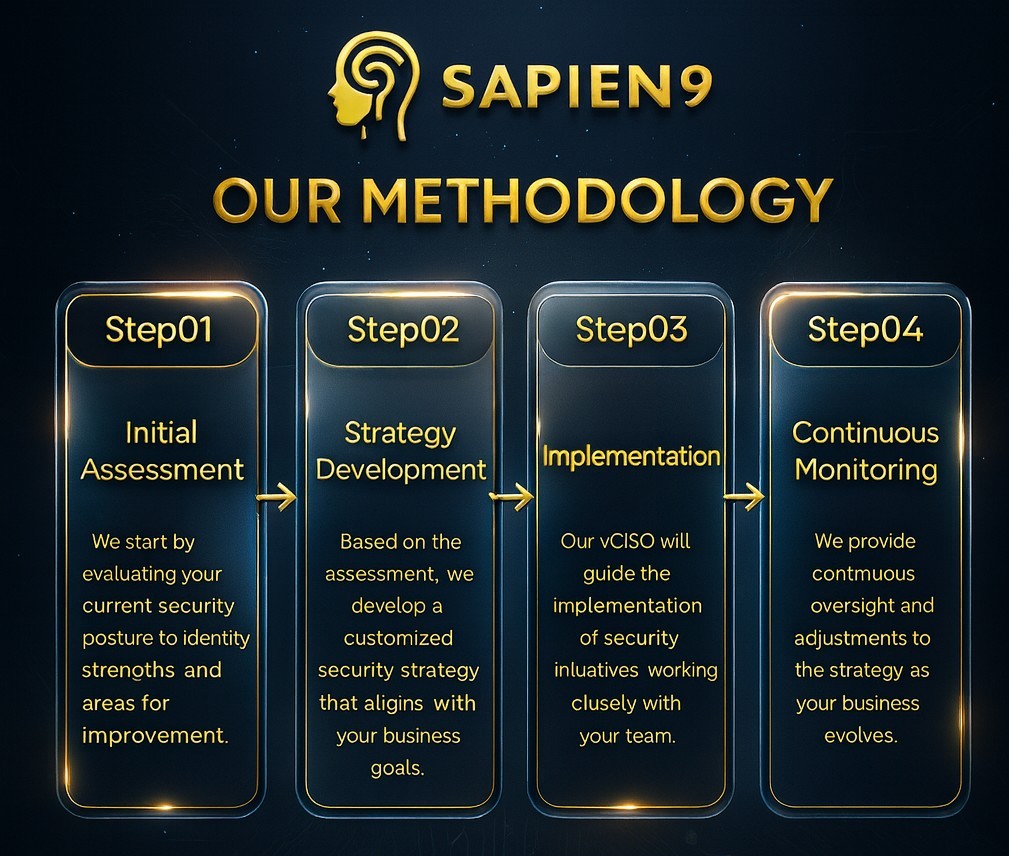
Initial Assessment
Expect the CISO to conduct a comprehensive review of your current cybersecurity posture, including infrastructure, policies, controls, and threat exposure. This phase should yield a clear baseline of strengths, vulnerabilities, and compliance gaps mapped against your business model, regulatory obligations, and operational priorities.
Strategy Development
The CISO translates assessment findings into a tailored cybersecurity roadmap. This includes prioritized initiatives, resource alignment, and governance structures that support business objectives. Expect clarity on risk tolerance, regulatory alignment, and transformation dependencies framed for executive decision-making.
Implementation Oversight
The CISO ensures that security controls are deployed effectively and integrated into business workflows. This includes validating technical configurations, coordinating with IT and DevOps, and ensuring that execution aligns with strategic intent. Expect oversight that balances speed, scalability, and resilience.
Monitoring & Reporting
Ongoing visibility into risk posture and compliance status is essential. The CISO should deliver regular reporting, both operational and executive-level, covering threat trends, control effectiveness, and regulatory alignment. Expect metrics that inform leadership decisions and reinforce board-level accountability.
Key Considerations When Selecting a vCISO Provider
To ensure your virtual Chief Information Security Officer (vCISO) delivers both strategic value and operational resilience, evaluate candidates across the following dimensions:
- Sector-Specific Expertise: Prioritize firms with deep experience in your industry and familiarity with its regulatory landscape.
- Professional Credentials: Confirm certifications such as CISSP or equivalent to validate cybersecurity proficiency.
- Proven Track Record: Request examples of successful incident response, compliance achievements, and measurable outcomes.
- Flexible Engagement Models: Assess whether hourly, retainer, or hybrid structures best align with your operational cadence and budget.
- Scalable Service Delivery: Ensure the provider can adapt as your organization grows or pivots.
- Seamless Integration: Favor vCISOs who collaborate effectively with existing IT teams and managed security service providers.
A high-performing vCISO should operate as a strategic extension of your executive leadership delivering insight, agility, and measurable impact without inflating overhead.
If you’d like, I can tailor this for board presentations, procurement teams, or investor-facing materials.
The cost of engaging a Virtual Chief Information Security Officer (vCISO) varies significantly based on organizational complexity, regulatory exposure, and the depth of services required. Executives evaluating this investment should consider both the engagement model and the strategic scope of services.
Engagement Models: Flexible Structures for Varying Maturity
Model | Typical Range | Best For |
Hourly Advisory | Billed per hour of work | Tactical guidance, audit prep, or incident response on demand |
Monthly Retainer | Fixed amount per month | Ongoing oversight, policy development, and executive reporting |
Project-Based | Predefined cost per project | Defined initiatives such as compliance programs, security frameworks, or readiness |
Key Pricing Drivers
- Organizational Scale and Complexity
- Small Enterprises (11–100 employees): Foundational security posture, basic policies, risk assessments, and compliance checklists.
- Mid-Market (100–500 employees): Broader scope, vendor risk management, incident response planning, and regulatory alignment.
- Enterprise-Level: Full-spectrum leadership, strategic integration with IT and executive teams, continuous monitoring, and board-facing governance.
- Scope of Services
- Strategic vCISO: Executive-level planning, governance frameworks, and policy architecture.
- Operational vCISO: Implementation oversight, audit readiness, and SOC coordination.
- Compliance-Focused vCISO: Specialized expertise in HIPAA, PCI DSS, CPRA, CJIS, HITRUST, or state-specific mandates.
Choosing the Right Pricing Model
Sapien9’s advisory framework helps organizations align vCISO engagement with business growth, regulatory posture, and board-level expectations. Whether you’re seeking fractional leadership or full-spectrum oversight, we tailor the structure to your strategic trajectory.
vCISO Certifications






Frequently Asked Questions
What is a CISO, and what defines a Fractional CISO?
A Chief Information Security Officer (CISO) is a senior executive responsible for shaping and executing an organization’s cybersecurity strategy. A Fractional CISO—often referred to as a Virtual CISO (vCISO)—delivers this leadership on a part-time or project basis, offering high-impact expertise without the cost of a full-time executive.
What size organizations do you typically support?
Our engagements focus on companies ranging from 11 to 10,000 employees, including departments or divisions within larger enterprises. For organizations outside this range, we’re happy to refer you to a vCISO partner better suited to your scale and complexity.
Do you support government entities?
We do support government organizations to include cleared required personnel.
How are your services priced?
Our pricing model is tailored to each engagement, factoring in organizational size, project scope, and infrastructure complexity. We also offer strategic clarity and cost predictability through hourly, by retainer, as well as per project.
Do you offer hourly billing?
Yes, we offer hourly billing for customers that require it.
Are you an auditor, penetration tester, or managed service provider?
While the focus of the vCISO service is strategic cybersecurity leadership, we provide other services that can be tailored to meet your needs.
Does a Sapien9 CISO bring coding expertise?
Technical fluency is valuable, but coding is not a typically a requirement. A vCISO’s primary mandate is strategic: managing cyber risk, ensuring compliance, and aligning security with business objectives. Leadership, governance, and cross-functional collaboration are paramount. However, if code expertise is a requirement, we will find the right individual with code expertise for the project at hand.
Is a CISO necessary for every organization?
Not all companies require a full-time CISO. Large enterprises and regulated industries often do need a CISO to comply with policies, rules, and regulations. For smaller or mid-sized firms, a vCISO offers scalable leadership aligned to risk tolerance, regulatory exposure, and growth trajectory.
Which compliance frameworks do you support?
We specialize in SOC 2, HIPAA, ISO 27001, GDPR, NIST, NERC, PCI DSS, CPRA, CFAA. and others. Our team ensures your organization meets certification requirements, enhancing trust, competitive positioning, and regulatory confidence.
How do you integrate with existing systems?
Our onboarding is designed for minimal disruption. We work closely with your internal teams to align with your current technology stack, workflows, and governance structures and thus ensuring seamless integration and strategic continuity.
How does outsourcing security and compliance reduce costs?
We deliver comprehensive, executive-grade services at a fraction of the cost without compromising quality, responsiveness, or strategic depth.
How do you accelerate sales cycles?
By proactively addressing security and compliance gaps, we streamline due diligence and reduce friction in procurement and partnership processes. This enables your sales team to close deals faster with confidence and credibility.
What ongoing support do you provide?
We offer continuous monitoring, policy updates, real-time threat detection, and strategic advisory. Our team remains engaged as your business evolves, ensuring your security posture adapts to new risks and opportunities.